Saturday, November 16, 2013

"he moves on a line, on which did he progress for centuries, he would but be carried further from them, instead of catching them up."

     "Now this, I fear, will seem a hard doctrine to some of us.  There are those, whom it is impossible not to respect and love, of amiable minds and charitable feelings, who do not like to think unfavorably of any one.  And, when they find another differ from them in religious matters, they cannot bear the thought that he differs from them in principle, or that he moves on a line, on which did he progress for centuries, he would but be carried further from them, instead of catching them up.  Their delight is to think that he holds what they hold, only not enough; and that he is right as far as he goes.  Such persons are very slow to believe that a scheme of general education, which puts Religion more or less aside, does ipso facto part company with Religion; but they try to think, as far as they can, that its only fault is the accident that it is not so religious as it might be.  In short they are of that school of thought, which will not admit that half a truth is an error, and nine-tenths of a truth no better; that the most frightful discord is close upon harmony; and that intellectual principles combine, not by a process of physical accumulation, but in unity of idea.
"It is true . . . that youths can be educated at Mixed Colleges of the kind I am supposing, nay at Protestant Colleges, and yet may come out of them as good Catholics as they went in.  Also it is true, that Protestants are to be found, who, as far as they profess Catholic doctrine, do truly hold it, in the same sense as that in which a Catholic holds it.  I grant all this, but I maintain at the same time, that such cases are exceptional; the case of individuals is one thing, of bodies or institutions another; it is not safe to argue from individuals to institutions. . . .
     "I allow all this as regards individuals; but I have not to do with individual teachers in this Discourse, but with systems, institutions, bodies of men.  There are doubtless individual Protestants, who, so far from making their Catholic pupils Protestant, lead  on their Protestant pupils to Catholicism; but we cannot legislate for exceptions, nor can we tell for certain before the event where those exceptional cases are to be found.  As to bodies of men, political or religious, we may safely say that they are what they profess to be, perhaps worse, certainly not better; and, if we would be safe, we must look to their principles, not to this or that individual, whom they can put forward for an occasion.  Half the evil that happens in public affairs arises from the mistake of measuring parties, not by their history and by their position, but by their accidental manifestations of the moment, the place, or the person. . . .  And the case is the same as regards the so-called approaches of heterodox bodies or institutions towards Catholicism.  Men may have glowing imaginations, warm feelings, or benevolent tempers; they may be very little aware themselves how far they are removed from Catholicism; they may even style themselves its friends, and be disappointed it does not recognize them; they may admire its doctrines, they may think it uncharitable in us not to meet them half way.  All the while, they may have nothing whatever of that form, idea, type of Catholicism, even in its inchoate condition, which I have allowed to some individuals among them. . . .  This is why some persons have been so taken by surprise at the late outburst against us in England, because they fancied men would be better than their systems.  This is why we have to lament, in times past and present, the resolute holding off from us of learned men in the Establishment, who seemed or seem to come nearest to us.  Pearson, or Bull, or Beveridge, almost touches the gates of the Divine City, yet he gropes for them in vain; for such men are formed on a different type from the Catholic, and the most Catholic of their doctrines are not Catholic in them.  In vain are the most ecclesiastical thoughts, the most ample concessions, the most promising aspirations, nay, the most fraternal sentiments, if they are not an integral part of that intellectual and moral form, which is ultimately from divine grace, and of which faith, not carnal wisdom, is the characteristic.  The event shows this, as in the case of those many, who, as time goes on, after appearing to approach the Church, recede from her.  In other cases the event is not necessary for their detection, to Catholics who happen to be near them.  These are conscious in them of something or other, different from Catholicism, a bearing, or an aspect, or a tone, which they cannot indeed analyze or account for, but which they cannot mistake.  They may not be able to put their finger on a single definite error; but, in proportion to the clearness of their spiritual discernment or the exactness of their theology, do they recognize, either the incipient heresiarch within the Church's pale, or the unhopeful inquirer outside of it.  Whichever he be, he has made a wrong start; and however long the road has been, he has to go back and begin again.  So it is with the bodies, institutions, and systems of which he is the specimen; they may die, they cannot be reformed."

     John Henry Newman, The idea of a university defined and illustrated, Appendices I:  1852 Discourse V, "General knowledge viewed as one philosophy" (ed. I. T. Ker (Oxford:  Clarendon Press, 1976), 430-434 (419-434)).
     Newman here responds to the suggestion that university instruction in religion can safely treat of "'general religion'" only, i.e., only "just as much as . . . Catholics and Protestants . . . hold in common" (428); a kind of "mere Christianity", as it were.  Interesting, in that light, that C. S. Lewis was never more than one of those "who seemed . . . to come nearest to us".

Friday, November 8, 2013

Running with the buffaloes

     “There was an anchorite in the desert grazing with the buffaloes and he prayed to God, saying:  ‘Lord, let me know if I am falling behind in anything.’  A voice came to him, saying:  ‘Enter this coenobion and, if they tell you to do anything, do it.’  He went into the coenobion and stayed there, but he had no idea how to serve the brothers.  The junior monks began teaching him how to serve, saying:  ‘Do this, idiot; do that, crazy old man.’  Hurt, he began to say to God:  ‘I have no idea how to serve men; release me back to the buffaloes.’  Released by God again, he went to a village to graze with the buffaloes.  Men used to set traps [in which] they caught buffaloes and the elder was caught [in one].  The thought suggested itself:  ‘Put your hand out and release yourself’, to which thought he said:  ‘If you are a man, release yourself then go to the men.  If, on the other hand, you are a buffalo, you do not have hands’, and he stayed in the trap, safe and sound, until dawn.  The men were alarmed on seeing the elder caught when they came to take the buffaloes.  For his part, he said nothing.  They released him and let him go; out he went into the desert, running with the buffaloes.”

     Ἦν τις ἀναχωρητὴς ἐν τῇ ἐρήμῳ βοσκόμενος μετὰ τῶν Βουβάλων καὶ ηὔξατο τῷ Θεῷ λέγων·  Κύριε, ἔι τι ὑστερῶ, δίδαξόν με.  Καὶ ἦλθεν αὐτῷ φωνὴ λέγουσα·  Εἴσελθε εἰς τόδε τὸ κοινόβιον, καὶ εἴ τι ἐπιτάσσουσι σοι, ποίησον.  Εἰσελθὼν δὲ εἰς τὸ κοινόβιον ἔμεινε καὶ οὐκ ἤδει τὴν ὑπηρεσίαν τῶν ἀδελφῶν.  Καὶ ἤρξαντο οἱ μοναχοὶ οἱ μικροὶ διδάσκειν αὐτὸν τὴν ὑπαρεσίαν λέγοντες·  Τοῦτο ποίησον, ἰδιῶτα, καὶ τοῦτο ποίησον, σαλὲ γέρων.  Καὶ θλιβόμενος ἠρξατο λέγειν πρὸς τὸν θεόν*·  Οὐκ οἶδα τὴν ὑπερεσίαν τῶν ἀνθρώπων·  ἀπόλυσόν με πάλιν εἰς τοὺς βουβάλους.  Καὶ ἀπολυθεὶς πάλιν ἀπὸ τοῦ Θεοῦ ἀπῆλθεν εἰς χωρίον βοσκηθῆναι μετὰ τῶν βουβάλων καὶ ἔστησαν παγίδας οἱ ἄνθρωποι ἐκεῖ καὶ ἐπίασαν βουβάλια.  Ἐπιάσθη δὲ καὶ ὁ γέρων καὶ λέγει αὐτῶ ὁ λογισμός·  Βάλε τὴν κεῖρα σου καὶ λῦσον σεαυτόν.  Εἴπεν δὲ πρὸς τὸν λογισμόν·  Εἰ μὲν ἄνθρωπος εἶ, λῦσον σεαυτὸν καὶ ὕπαγε πρὸς τοὺς ἀνθρώπους, εἰ δὲ βούβαλος εἶ, οὐκ ἔχεις χεῖρας.  Καὶ ἔμεινεν εἰς τὴν παγίδα σῶος ἕως πρωΐ.  Ἐλθόντες δὲ οἱ ἄνθρωποι πιᾶσαι τοὺς βουβάλους καὶ ἰδόντες τὸν γέροτα πεπιασμένον ἐφοβήθησαν.  Καὶ αὐτὸς οὐκ ἐλάλησεν οὐδέν.  Καὶ λύσαντες αὐτὸν ἀφῆκαν, καὶ ἐξῆλθε τρέχων ὀπισω τῶν βουβάλων εἰς τὴν ἔρημον.

* S:  Κύριον
C omits Οὐκ οἶδα τὴν ὑπερεσίαν τῶν ἀνθρώπων·

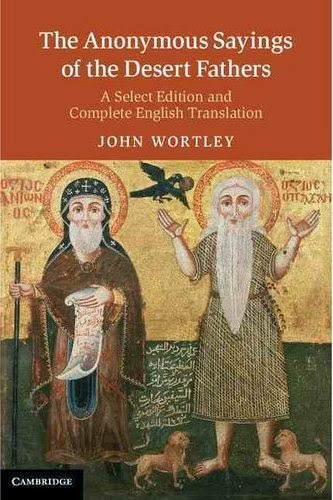
     Anonymous saying of the Desert Fathers no. 516.  The anonymous sayings of the Desert Fathers:  a select edition and complete English translation, ed. & trans. John Wortley (Cambridge:  Cambridge University Press, 2013), 348-351.
     No. 62, on p. 55, is very similar:
     "There was an anchorite grazing with the antelopes [(Βουβάλων)] and he prayed to God saying:  'Lord, teach me in what I am lacking.'  A voice came to him saying:  'Go to such-and-such a coenobion and do whatever they order you.'  He entered the coenobion and stayed, but he did not know how to serve the brothers.  The junior monks started instructing him how to serve the brothers, saying to him:  'Do this, stupid' and:  'Do that, crazy old man.'  Distressed, he prayed to God saying:  'Lord, I do not know how to serve men; send me back to the antelopes again.'  Released by God, he went off again into the countryside to graze with the antelopes [(Βουβάλων)]."
     Why does Worley translate these so differently?  The French translation by Lucien Regnault (Les sentences des pères du désert:  série des anonymes, Spiritualité orientale 43 (Solesmes & Bellefontaine, 1985), pp. 188-189 and 34 respectively) seems more consistent.

Saturday, November 2, 2013

Bossuet on the priesthood of all believers

"When one speaks in the presence of the faithful either of the duties of the priesthood or of the powers of ecclesiastics, they think that these discourses touch upon them not at all, and refer the whole practice of these duties either to the sacerdotal order or to consecrated persons.  But it is a Christian truth that, a spiritual impression of the character of the pontificate of our Lord Jesus Christ [(Heb 7-8)] being made on us by Holy Baptism, all those who are honored to be his members are also participants of his priesthood; and that, by consequence, they must take part, according to the measure that is given to them, in the Spirit and in the functions of his priesthood.  This is what the learned Saint Chrysostom explains very excellently by the very order of sacrifice, in which the people are united with the priest in [the] company of the same Spirit; in which the priest, although appearing alone at the altar, nevertheless carries [to it] the desires of all and speaks in the name of the entire holy congregation, instructing the children of God by this holy ceremonial that they are truly united with him in a priestly and apostolic Spirit [(Hom. 18.3, on 2 Cor 8:16)].  This is why I am persuaded, Messieurs, that what I have to say today on the holy pontiff [Saint Charles Borromeo], whose memory we honor, although regarding the ecclesiastical state above all, will not, however, be irrelevant to the rest of my auditors.  And as I intend to help you see that the Spirit of the priesthood obliges all Christians to consecrate themselves to God as victims, I hope that the faithful, whom the blood of the Savior of the world has made both priests [of] and sacrificers to the living God, will understand by this doctrine that they are obliged to present themselves as holy, living, and acceptable oblations through Jesus Christ to the eternal Father [(Rom 12:1)].  But as Saint Paul assures [us] that this sacrifice must be consummated in the Spirit of the same Jesus, and because I learn from the same apostle that this Jesus offered himself to his Father by the Holy Spirit [(Heb 9:14)], let us ask this same Spirit to produce the abundance of grace in our hearts in order that they might be transformed into living victims; but let us request this grace via the intercession of Mary, by addressing her [as follows]:  Ave [Maria]."

     From the first installment in the Bibliothèque de la Pléiade I've ever had the good fortune to own (i.e. pick up used).  It came down to me from the library of John P. O'Connell.  Fr. Jacques-Bénigne Bossuet, "Panégyrique de Saint Charles Borromée" (Paris, 4 November [1656]), in Bossuet:  oraisons funèbres, panégyriques, Bibliothèque de la Pléiade 33, ed. the Abbé Bernard Velat (Paris:  Librairie Galllimard, 1951):  674-675.  1656 is the date suggested by the Abbé Velat, who nevertheless admits that "On peut hésiter entre 1656, 1659 et 1661."  Bossuet was not a bishop until 1669.


Thursday, October 24, 2013

"Then there are the fanatical atheists whose intolerance is the same as that of the religious fanatics, and it springs from the same source. . . . They are creatures who can't hear the music of the spheres."

     Albert Einstein to an unidentified person, 7 August 1941, as quoted in The ultimate quotable Einstein, ed. Alice Calaprice (Princeton: Princeton University Press, 2011), 337.  Calaprice cites Einstein Archives 54-927 (Hebrew University, Jerusalem).
     Einstein was of course not a believer in any traditional or confessional sense.

Sunday, October 20, 2013

"Physical Science is the richer, Theology the more exact; . . ."

     John Henry Newman, The idea of a university defined and illustrated, Discourse VII.6, "Christianity and physical science:  a lecture in the School of Medicine" (ed. I. T. Ker (Oxford:  Clarendon Press, 1976), 356).
     "richer" in the sense of having "its own [(I hesitate to say more)] exuberant sylva of phenomena" "to handle, weigh, and measure"; "more exact" in the sense that Theology operates via deduction from "certain truths, communicated directly from above" ("The argumentative method of Theology is that of a strict science, such as Geometry, or deductive; the method of Physics, at least on starting, is that of an empirical pursuit, or inductive" (355-356)).
     Cf. this with, say, the more complicated account of "Physics" given by Ernan Mcmullin.

"Resist the devil", and he will make his presence known

"A brother told some elder:  'I do not see any battle in my heart.'  'You are a building open on all four sides', the elder said to him.  'Whoever wishes comes in and out through you and you are not aware of it.  If you have a door and close it, refusing entry to wicked logismoi through it, then you will see them standing outside and doing battle.'"

     Anonymous saying of the Desert Fathers no. 270 = N.57/11.101.  The anonymous sayings of the Desert Fathers:  a select edition and complete English translation, ed. & trans. John Wortley (Cambridge:  Cambridge University Press, 2013), 183.

Non-overlapping magisteria

"we may wait in peace and tranquillity till there is some real collision between Scripture authoritatively interpreted, and results of science clearly ascertained, before we consider how we are to deal with a difficulty which we have reasonable grounds for thinking will never really occur."

     John Henry Newman, The idea of a university defined and illustrated, Discourse VII.5, "Christianity and physical science:  a lecture in the School of Medicine" (ed. I. T. Ker (Oxford:  Clarendon Press, 1976), 355).