Thursday, August 9, 2018

Performativity

"divine scripture teaches us that we will only obtain this [(our greatest likeness to and union with God)] through the most loving observance of the august commandments and by the doing of sacred acts."

  Pseudo-Dionysius, Ecclesiastical hierarchy 2.1, trans. Colm Luibheid (CWS (New York:  Paulist Press, 1987), 200).

Ταύτης [(ἡ πρὸς θεὸν ἡμῶν ὡς ἐφικτὸν ἀφομοίωσίς τε καὶ ἕνωσις)] δέ, ὡς τὰ θεῖα διδάσκει λόγια, ταῖς τῶν σεβασμιωτάτων ἐντολῶν ἀγαπήσεσι καὶ ἱερουγίαις μόνως τευξόνεθα.

     Corpus Dionysiacum 2, ed. Heil & Ritter (Berlin:  Walter de Gruyter, 1991), 68.  =PG 3, col. 392A.  From the immediate context, the sacred acts in question would appear to be those acts of obedience, of keeping Christ's word (Jn 14:23), to which one is bound by the rite of baptism.  Yet there is also this larger emphasis on the Christian mysteries.  I was put onto these words by Margaret R. Miles, who quotes it in the context of an emphasis on "dehabituating exercises, thoughts, visualizations, bodily postures, . . . verbal formulae," etc. (Practicing Christianity:  critical perspectives for an embodied spirituality (New York:  Crossroad, 1988), 90).

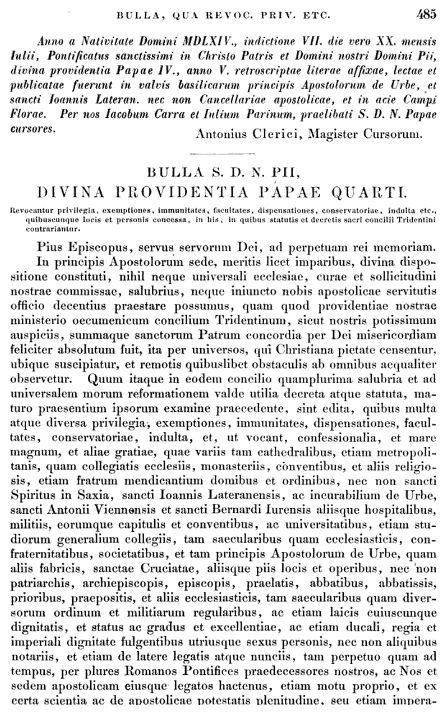
What does the abbreviation "S. D. N. D.", common in papal bulls of the 16th century at least, stand for?


Here's my first guess:
". . . Sancti(ssimi) Domini Nostri, Domini [Pii] . . ." (where the second and largely superfluous occurrence of "Domini" is sometimes dropped, as in the abbreviation "S. D. N.") 
". . . of Our (Most) Holy Lord, the Lord [Pius] . . ."
See, for example, the top of this page in the important 1853 Richter/Schulte edition of the Canones et decreta Concilii Tridentini here, where, however, some additional words intervene, so that what you get, severely abbreviated further on down as "S. D. N.", is
". . . the pontificate of Our Most Holy Father in Christ and Lord, the Lord Pius IV, by divine providence Pope . . ."
Cf. these 19th-century translations of the Tridentine bulls of Pius IV (just one in a whole series of bulls that begin in this way).  Cf. also (as some specialists on FICINO reminded me) Cappelli's Dizionario di abbreviature latine ed italine, sv S.D.N.

Wednesday, August 8, 2018

"the lasting presence of the temporal before the eternal God may become the experience of the temporal itself. . . ."


     Wolfhart Pannenberg, "Theological questions to scientists," Zygon 16, no. 1 (March 1981):  74 (65-77).

Thursday, August 2, 2018

Marriage

"You've got to go into the thing with your eyes shut, lowering your head, kissing the ground, and—for the rest—putting your trust in God, as long as you've decided to do it."

"Il s’y convient mettre à l'aventure, les yeux bandés, baissant la tête, baisant la terre, et se recommandant à Dieu au demeurant, puisqu’une fois l’on s’y veut mettre.  Autre assurance ne vous en saurais-je donner.”

     Pantagruel to Panurge, Gargantua and Pantagruel III.10, trans. Burton Raffel ((New York:  W. W. Norton & Co., 1990), 269).  That at the head of some 30 chapters on the theme (chaps. 9-48 at least).  Trans. Urquhart and Motteux:

It is therefore expedient, seeing you are resolved for once to take a trial of the state of marriage, that, with shut eyes, bowing your head, and kissing the ground, you put the business to a venture, and give it a fair hazard, in recommending the success of the residue to the disposure of Almighty God.

Luther on the importance of the fight at precisely the one position under assault

"Neither is it of any help if someone would say, 'I will gladly confess Christ and His Word in every other article, except that I may keep silence about one or two that my tyrants may not tolerate, such as both species in the Sacrament and the like.' For whoever denies Christ in one article or word has denied the same Christ in that one article who would be denied by [denying] all the articles, since there is only one Christ in all His words, taken all together or singly."

"Auch hilft nicht, daß jemand wollt sagen:  'Ich will in allen Stücken sonst gern Christum und sein Wort bekennen, ohn daß ich müge schweigen eines oder zwei, die meine Tyrannen nicht leiden mögen [(or: die mein Tyrann nicht leiden mag)], als die zwo Gestalt des Sacraments oder desgleichen.'  Denn wer in einem Stück oder Wort Christum verleugnet, der hat ebendenselbigen Christum in dem einigen Stück verleugnet, der in allen Stücken verleugnet würde, sintemal es nur ein Christus ist, in allen seinen Worten sämptlich und sonderlich."

     Martin Luther, Letter 619 to Count Albrecht von Mansfeld, dated 3 June 1523.  WA Bw 3, 81 ff., trans. Dr. Christopher Brown (except that I have re-consulted the WA edition of the original German and re-introduced here the two emphases ("einem" and "ein") missing at that link).  Cf. Pseudo-Luther on the importance of the fight at precisely the one position under assault.

"What [w]e mustn't do is say to [ourselves], 'God doesn't mind [the] sins of the flesh'"

Andrea Solario, Wikimedia Commons
     "Sometimes people who commit this sin [(here specifically adultery, but in the passage at large fornication)] treat it lightly out of heaven knows what kind of perversity.  They hunt about for heaven knows what null and worthless proofs in their support, and they say, 'God doesn’t mind the sins of the flesh [(Peccata carnis Deus non curat)].'  Well, what about what we have heard today, Fornicators and adulterers God will judge (Heb 13:4)?  So there you are, pay attention, any of you afflicted with this sort of disease [(quisquis tali morbo laboras)].  Listen to what God is saying, not to what your own prejudice is saying in favor of your sins [(quod dicit Deus audi:  non quod tibi dicit favens peccatis tuis animus tuus)]. . . .
     "What he [(the one who fears God)] mustn’t do is say to himself, 'God doesn’t mind sins of the flesh.' [(Non dicat in cordo suo, Peccata carnis non curat Deus.)]  Do you not know, says the apostle, that you are the temple of God, and the Spirit of God dwells in you?  Whoever violates God’s temple, God will destroy him (1 Cor 3:16-17).  Don’t deceive yourselves, any of you[.]  But someone will say, perhaps, 'God’s temple is my mind, not my body,' adding the proof text, All flesh is grass, and all the splendor of the flesh as the flower of grass (Is 40:6).  Miserable interpretation, punishable thought! . . . you can’t make light of bodily sins [(Jam non contemnatis corporalia peccata)]. . . . Your very body is the temple of God’s Spirit in you. . . .
". . . A temple you come in, a temple you go out, and temple you stay at home, a temple you get up [(Templum intras, templum exis, templum in domo tua manes, templum surgis)].  Mind what you do, mind you don’t offend the inhabitant of the temple, or he may abandon you and you will fall into ruin.  Do you not know, he says, that your bodies (and here the apostle was talking about fornication, in case they should make light of bodily sins) is [(sic)] the temple of the Holy Spirit in you, which you have from God, and you are not your own?  For you have been bought for a great price."

     St. Augustine, Sermon 82.8.11 and 10.13 (408), trans. Edmund Hill, O.P. (WSA III.iii, Sermons III (51-94) on the New Testament (Brooklyn:  New City Press, 1991), 375-377) =PL 38, cols. 511-512 (506-514).
     Cf. St. John the Baptist.

Wednesday, August 1, 2018

"If you neglect to [reprove him], you are worse than he is."

"But what about those who have suffered an injury, what ought they to do?  What we have heard in today’s gospel:  If your brother has sinned against you, reprove him between yourself and him alone.  If you neglect to do so, you are worse than he is [(Si neglexeris, pejor es)].  He has done wrong, and by doing wrong has inflicted a grave wound on himself; are you going to ignore your brother’s wound?  You see that he’s on the point of being lost, or is already lost, and are you not going to bother?  You’re worse by keeping silent than he was by noisily abusing you."

     St. Augustine, Sermon 82.4.7 (408), trans. Edmund Hill, O.P. (WSA III.iii, Sermons III (51-94) on the New Testament (Brooklyn:  New City Press, 1991), 372) =PL 38, cols. 508-509 (506-514).  Cf. the "Si neglexeris corrigere, peior eo factus es qui peccavit" cited by Aquinas at ST II-II.33.2.Sed contra (from, supposedly, the De verbo Dom. xvi.4, but which vol. 34 of the Blackfriars edition, p. 279n5, also traces to Sermon 82).
     St. Augustine goes on to distinguish between the response to private and public sin (10):
Those sins, then, are to be rebuked in front of everybody which are committed in front of everybody.  Those which are committed less publicly are to be rebuked less publicly.  Distinguish between the occasions. . . .
(And do it for the right motives, i.e. the recovery/salvation of the sinner.)